How to Assemble an Outdoor Furniture Setting in 90 Minutes
The first wicker setting I ever built in Perth was an 8-piece corner lounge from Eden Outdoor. Four hours, two skinned knuckles, and a thumb that throbbed for a week. The Allen key the box ships with is a 4mm L-shaped torture device and there are 86 bolts in that flat-pack. After that day I never touched another bare Allen key for outdoor furniture. The trick is dead simple: stick a hex bit into your 18V impact driver, drop it to the lowest torque setting, and let the tool do the work. A 4-hour build collapses to 90 minutes. Same setting, same bolts, you just stop being the torque source. I’ve now done this routine on Garden Living, Eden, OZ Design, Bunnings Mimosa and a Marquee setting from Bunnings — same approach every time. Worth doing once, worth doing right.
What you’ll need
- 18V impact driver — Makita DTD153, Ryobi One+ R18IDBL or Ozito PXC, any of them work
- Set of hex bits 3mm, 4mm, 5mm, 6mm — the Bosch 25-piece “impact tough” set from Bunnings is the one I use
- 1/4-inch hex socket adapter for the impact (for socket-head nuts)
- 13mm and 10mm sockets — most outdoor settings use M6 and M8 bolts
- Rubber mallet
- Cordless drill with a Phillips bit for any timber-frame bits
- A drop sheet or old picnic blanket — wicker scratches concrete and concrete scratches wicker
- A mate for five minutes when you flip the lounge over
- Marine grease — Inox MX3 or Lanotec — for bolt thread protection
Step 1: Lay everything out before you touch a tool
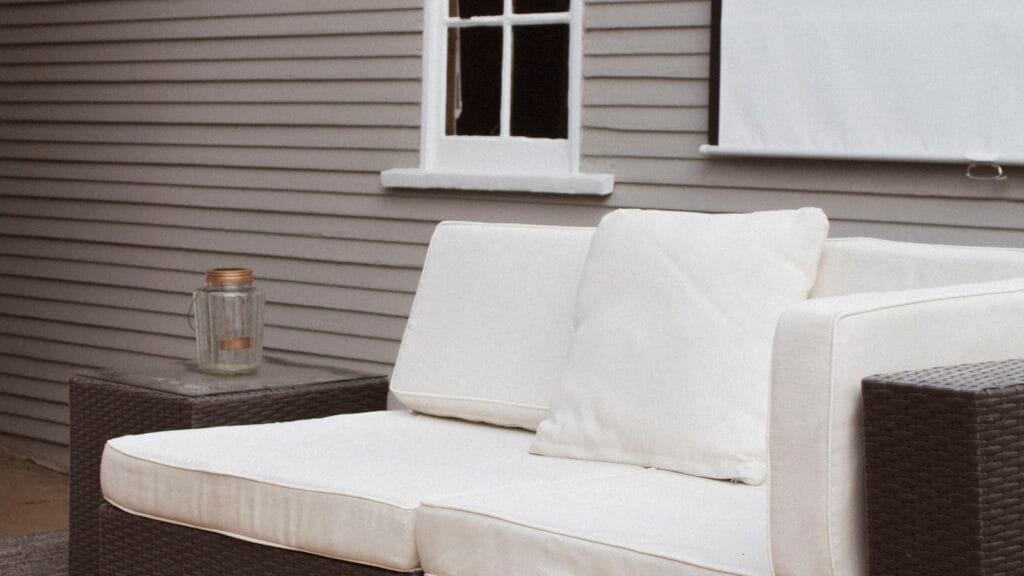
Open the box on the drop sheet. Pull every part out, lay them in a grid, and cross-check against the parts list. Aussie outdoor furniture is shipped from China via a Melbourne or Brisbane warehouse, and pickers miss things. I’ve had three sets in two years arrive with a missing bolt pack. If you find it now, you ring Garden Living or Bunnings before you’ve half-built anything. If you find it at step seven, you’ve got a half-assembled lounge sitting in the driveway for three days. Group bolts by length and head type into little piles — plastic takeaway containers work great. Stainless in one container, zinc-plated in another (more on that in step 5).
Step 2: Read the diagram backwards
Aussie flat-pack instructions are translated from Mandarin and the order is often wrong. Read the last page first to see what the finished piece looks like, then work out which subassembly is which. I’ve found Eden’s manuals are usually correct; Mimosa’s and the cheaper Bunnings settings are 50/50. If the printed diagrams are unclear, the QR code on the inside of the box usually goes to a YouTube assembly video — those are way clearer than the booklet.
Step 3: Set the impact to its lowest torque or “1”
Critical bit. An 18V impact on full noise will strip the soft aluminium threads on most outdoor frames in one trigger pull. On the Makita DTD153 it’s the half-press of the trigger. On the Ryobi R18IDBL there’s a 3-stage selector — use stage 1. On Ozito it’s the speed dial set to 1. The rule: tighten to “snug plus a quarter turn”. If you hear the impact start to chatter — that rapid hammering sound — you’re done. Stop. Don’t let it ratchet a second time. Stripped threads on a wicker setting are exactly how it gets cut up for council pickup in three years.
Step 4: Build the heaviest piece first
The corner module on a wicker setting is the heaviest and the most awkward to flip. Build it first while you’re fresh and your back’s not sore. Smaller chairs and the coffee table are 10-minute jobs at the end. Lay the frame upside down on the drop sheet. Bolt the legs on. Flip with your mate (don’t try it alone — wicker with no cushions is still 25kg and the frame flexes). Bolt the cross braces. Done. If you’re also building a BBQ in the same session, same rule: heavy unit first, smaller bits after.
Step 5: Don’t mix stainless and zinc-plated bolts on the same piece
This is the Aussie gotcha and the reason I bothered writing this. Garden Living and Eden both sometimes ship a mix — stainless for the outside fixings where you can see them, zinc-plated for the hidden cross braces where they save 30 cents a bolt. If you accidentally swap them around — put a zinc-plated bolt where a stainless one should be — you get galvanic corrosion. On the coast (and Perth’s coast counts, even down to Cottesloe and Fremantle), salt air will turn that mismatched joint into a rusted locked-thread mess in six months. You’ll never get it apart for storage or moving. I’ve cut three settings apart with an oscillating multi-tool because of this. Rule: bolts go back exactly where they came out of the parts pack. Shiny dull-grey and non-magnetic = stainless. Bright silver and a magnet sticks = zinc-plated. Don’t mix.
Step 6: Use the rubber mallet on wicker frames before you tighten
Wicker frames are powder-coated aluminium and the holes are sometimes 0.5mm out of alignment from packing. A whack with the rubber mallet brings the holes into line. Tighten the bolt finger-loose first, mallet the joint flush, then run the impact. Otherwise you cross-thread the bolt or pull the powder coat off the joint. Hard-and-fast rule: never force a bolt into a misaligned hole. Mallet first, bolt second.
Step 7: Cushions go on AFTER the frame is fully tightened
I see people build a chair, throw the cushions on, then sit in it to test, then realise a brace is loose. Build the entire setting frame-only first. Walk around. Push every joint. Then cushion up. The cushion covers on most Aussie outdoor settings have YKK zips — they’re fine, but check them now while you remember. Cheap zips fail in the first summer and the warranty claim gets messy if you’ve already used the cushions.
Step 8: Apply a tiny dab of marine grease to every external bolt thread
Optional but takes five minutes and saves the setting in year four. Inox MX3 or Lanotec from Bunnings — a smear on the threads as you tighten. It stops bolt-head corrosion and means you can disassemble the setting in five years if you move house. Without it, every bolt head is a rusted nub and you’ll cut the setting up for council pickup. Five-minute job, decade of insurance.
Step 9: Tighten the legs with a torque-aware feel, not the impact
Legs are the one place I switch back to a manual hex key — but only for the last quarter turn. Impact-driver the leg bolt to snug, then finish with the L-key. Reason: leg bolts pull straight against the floor and an over-tightened leg bolt cracks the powder coat. A cracked powder coat coastal-side is a six-month rust spot. Better to be 5 percent under than 5 percent over on leg bolts.
Step 10: Sit, push, listen, retighten in 24 hours
After build, sit in every chair, lean back hard, listen for clicks. Any click equals a loose bolt — find it now. Then 24 hours later, after the frame’s settled under load, walk around with the impact and retighten everything (still on torque 1). Bolts settle. They always settle. The 24-hour retighten doubles the life of the setting and stops every joint working loose by year two. Same rule when you build a garden shed — settle and retighten the bolts on day two.
When to call a tradie or pro
Standard outdoor furniture assembly is squarely DIY. Times to bring in someone else: built-in outdoor kitchens and BBQ benches — if you’re integrating the setting into a built outdoor kitchen with stone benchtops, gas lines or hardwired lighting, that’s licensed gas-fitter and electrician work. Pergola or shade-sail anchoring for the area above the setting — if you’re bolting a permanent structure to brickwork, get a licensed builder or carpenter to handle the structural fixings. Trampolines if the kids’ tramp is going next to the lounge — AS 4989 says trampolines in cyclone-prone or high-wind zones need engineered anchors. The wicker setting itself you’ll knock out in a Saturday morning, no worries.
Common screw-ups
- Impact on full torque: strips aluminium threads in one pull. Always torque setting 1.
- Mixing stainless and zinc bolts: galvanic corrosion locks the joint within six months on the coast.
- Skipping the rubber mallet on misaligned holes: cross-threaded bolt, pulled powder coat. Mallet first.
- Building solo on the corner module: wicker frame flexes, panels twist. Grab a mate for the flip.
- No marine grease on threads: rusted bolt heads in year four, no disassembly possible.
Cost & time
A mid-range 8-piece wicker setting from Bunnings, Eden or Garden Living runs $1,200-3,500. Tools you’ll already have if you’ve done any DIY — 18V impact driver $150-250, hex bit set $30, marine grease $15. Build time: 90 minutes for an experienced assembler with the impact-driver method; 3-4 hours first-time with the supplied Allen key. The impact method genuinely halves the job.
Storage and seasonal care
Aussie wicker is mostly synthetic PE rattan over an aluminium frame — UV-stable but not bulletproof. WA, NT and northern QLD will fade synthetic rattan in three years of full sun. A good outdoor cover ($60 from Coverstore or Bunnings) extends life dramatically. Off-season, store cushions inside or in a sealed bin — even waterproof cushions soak up overnight humidity and grow mould inside the foam. For coastal Perth, Sydney and Gold Coast, hose the setting down monthly with fresh water — salt crystallises on the powder coat and accelerates corrosion. Thirty seconds with a garden hose adds years.
Match the metal, low torque, mallet first, retighten in 24 hours. Do those four things and a wicker setting that’s rated for five years on the coast will give you ten. Skip them and youll be cutting bolts off with an angle grinder before the second summer. While you’ve got the impact driver out, knock out the BBQ assembly or that flat-pack shed kit sitting in the driveway. Beauty.