How to Use Extension Cords and Powerboards Safely in Australia
A mate of mine — a sparky’s wife, ironically — rang me out one Friday because her home office powerboard was making a “kind of crackly noise”. I drove over, pulled out the cabinet, and found a six-way powerboard plugged into another six-way powerboard plugged into a 7.5A indoor extension cord that snaked under a rug to a wall outlet six metres away. Hanging off the chain: a 2400W oil column heater, two laptops, three monitors, a printer, a router, a phone charger, a desk lamp and a 1500W space heater “for the kids’ room in winter”. The upstream powerboard was browning around the outlets. Another two weeks of cold mornings and that home office would have been ashes. I gave her the four-rule check, swapped the daisy-chain for a proper RCD powerboard, and got her sparky husband to install another double GPO the following weekend. Fire & Rescue NSW publishes the home electrical fire stats every year and extension cords and powerboards top the list every year. The rules are technical, the marketing on the box is misleading, and the consequences are real. Here’s the four-rule version.
What you’ll need
- A torch for inspecting cords behind furniture
- A roll of cable ties or Velcro straps for tidying up
- Possibly: a new powerboard with built-in RCD (Clipsal, HPM or Arlec, $35–$60 at Bunnings)
- Possibly: a 15A extension cord if you have caravan-plug appliances
- A label maker or masking tape and a biro
- A spare bin liner for any damaged cords or melted boards you’re about to throw out
Step 1: Understand the amp rating on every cord
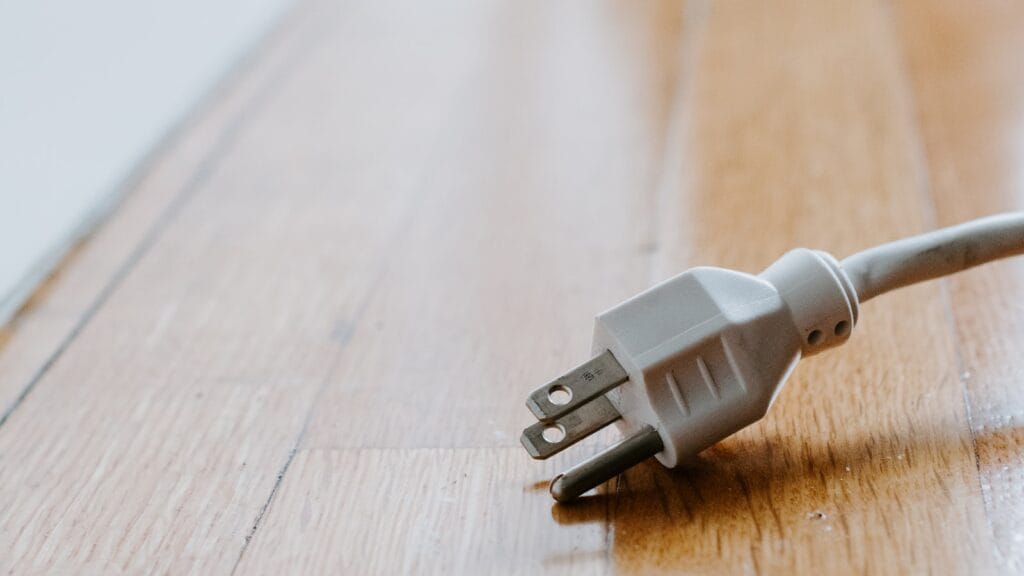
Every Aussie extension cord is rated in amps and the rating is printed on the cord itself near the plug, not on the box. The common ratings: 7.5A cheap indoor cords for lamps and small appliances ($9 Bunnings specials); 10A standard “heavy-duty” Aussie domestic cord, suits anything with a normal flat-three-pin plug; 15A caravan-style red plug, required for high-draw appliances — most outdoor heaters, large kettles, welders, some workshop tools. The catch: a 10A cord plugged into a 10A wall outlet seems fine, but if you’re running a 15A appliance via an adapter, you’ve now got 15 amps trying to flow through a cord rated for 10. Resistive heating goes up with the square of current — a 50% overload generates 2.25× the heat. The PVC insulation softens, melts, and one day catches.
Step 2: Rule 1 — cord rating matches appliance draw
Walk every extension cord in the house. Read the amp rating on the cord. Read the amp rating on the appliance plate (back of the heater, base of the kettle, side of the tool). If the appliance draw exceeds the cord rating, the cord is wrong. Most outdoor patio heaters draw 2400W = 10A — right at the limit. Add a fan, it’s over. Most caravan-plug appliances are 15A by definition. Tradie kettles and air compressors often want 15A. Don’t “she’ll be right” this — overheating is a slow failure, you won’t notice until you smell it, and by then there’s already carbon in the cable jacket. AS/NZS 3000 and AS/NZS 3760 both spell this out clearly.
Step 3: Rule 2 — RCD protection at the source
Under AS/NZS 3000, every powerpoint installed in a domestic dwelling since 1991 must be RCD-protected (residual current device, trips in 30 ms on earth fault). Sounds like every house should be safe. In practice, plenty aren’t — the rule grandfathered pre-1991 installations, and lots of homes have had renovations where new circuits were added without re-tripping the whole board to RCD coverage. Find your switchboard. Look for switches labelled “Safety Switch” or “RCD” with a “T” test button. Press the test button on each RCD — the matching switch should trip. If a circuit doesn’t have an RCD, get a sparky to add one (about $250 a circuit). For belt-and-braces, use an RCD powerboard on any high-risk circuit — Clipsal, HPM Excel, Arlec Pro all do them for $35–$60. See how to reset a tripped safety switch for diagnosing nuisance trips after upgrading.
Step 4: Rule 3 — no daisy-chaining powerboards
Plugging a powerboard into another powerboard (“daisy-chaining”) is explicitly called out in fire-and-rescue insurance assessment guidelines as a banned practice. If a fire starts and the assessor finds a daisy-chain, your home insurance can refuse to pay. Same for plugging an extension cord into a powerboard, then another powerboard into the cord. The reason: each board adds resistance, and the upstream board carries the combined load of everything downstream — easily exceeding the 10A wall outlet capacity. The board itself doesn’t know; it’ll let you draw 25A through a 10A connection until something melts. One powerboard per outlet. If you need more outlets in one spot, buy an 8-way or 10-way single board, or get a sparky to install another double GPO. Never daisy-chain.
Step 5: Rule 4 — no concealed cord runs
Extension cords run under rugs, behind couches pressed against the wall, under doors, or stapled to skirting are all fire risks. The cord can’t dissipate heat — rugs and carpet are insulators. Foot traffic stresses the conductors at the entry point. Door-edge crushing breaks the inner copper but leaves the outer PVC intact — looks fine, runs hot, eventually arcs in the wall cavity. If you must run a cord across a walked area, use a proper rubber speed-bump-style cord cover ($25 at Bunnings) or get a sparky to install a powerpoint where you actually need it. An extension cord is supposed to be a temporary solution; if it’s been there six months, get a real outlet.
Step 6: Inspect every cord for damage
Walk every extension cord in the house with a torch. Look for cracked or split PVC, exposed copper, scorch marks at the plug, bent pins, looseness where the cord enters the plug. Any of those = bin the cord. Don’t tape it. Don’t “use it carefully”. A damaged cord is the start of an arc fault, and arc faults start fires inside walls and behind furniture where you can’t see them. Workplace cords get tested under AS/NZS 3760 (test and tag) every 3–12 months. Domestic cords aren’t legally required to be tagged but the same principles apply — visual check every six months, replace anything damaged immediately. I get this question alot: “Can I splice a damaged cord with electrical tape?” No. Bin it.
Step 7: Total up the load on each powerboard
A 10A outlet delivers 10A total no matter how many sockets the powerboard has. Add up appliances: laptop 0.5A, phone charger 0.2A, TV 1.0A, soundbar 0.5A, wifi 0.5A, console 1.5A — total 4.2A, fine. Add a 2400W heater (10A) and you’re at 14.2A through a 10A outlet. Cheap overload protectors don’t always trip. Heat-producing appliances should go straight to a wall GPO, not via a board.
Step 8: Outdoor and wet-area cords need the right rating
Indoor cords are not rated for outdoor use. Look for the IP rating — IP44 minimum for outdoor splash, IP65 for hose-down. The cord needs to be outdoor-rated AND the plug-to-cord junction needs to be off the ground or in a weatherproof enclosure. A puddle reaching the join is an instant short circuit; on an RCD-protected outlet that just trips, but on a non-RCD circuit it’s a fire or shock risk. For caravan, camping, workshop, or job-site use, get an industrial cord (orange high-vis PVC, hard rubber compound) rather than soft-domestic indoor cord. Sold at Reece, Bunnings Trade and electrical wholesalers — about double the price, ten times the life.
Step 9: Label every powerboard and cord
Sounds nerdy. Do it anyway. Label each board with what’s plugged in (“desk”, “TV”, “kettle/toaster”) and the total amp draw. Label each extension cord with its rating. Takes 30 seconds and means the next time you’re tempted to plug a heater into something you know instantly whether the cord handles it. See also how to test and replace smoke alarms.
Step 10: Audit and re-check every six months
Stick a recurring calendar reminder on your phone. Every six months walk the house, repeat the four-rule check, look for new daisy-chains the kids have created behind the TV, check for cords migrated under rugs, check the powerboards for browning or hot-to-touch plastic. Most fires I attend traced back to a setup that was fine when installed and crept into danger over months. The audit is the cheapest insurance you’ll buy.
When to call a tradie
Permanent extension cord runs are a sign you need a sparky to install a powerpoint, not a longer cord. Adding a GPO where you need one is $150–$250. Adding a board-level RCD is $250 a circuit. A full board upgrade with whole-of-house RCDs is $1,500–$2,500. A pre-1970s switchboard with no RCD coverage at all is a strong upgrade candidate. All licensed work under AS/NZS 3000 — nothing in this list is DIY-able. The four-rule check IS yours; everything past “install a new GPO” is mine.
Common screw-ups
- Daisy-chaining powerboards to “add outlets” — voids insurance, causes most domestic electrical fires.
- Running cords under rugs for “neatness” — can’t dissipate heat, eventually arcs.
- Trusting the “heavy duty” label on a cord box without reading the amp rating on the cord itself.
- Using indoor cords outdoors for “just a quick job” — water in the join trips RCDs at best, kills people at worst.
- Plugging a 2400W heater into a 10A powerboard with seven other things — total overload, plastic melts.
Cost & time
RCD powerboard: $35–$60. 15A red-plug extension cord: $40–$80 depending on length and quality. Industrial outdoor cord 15 m: $90. New GPO installed by a sparky: $150–$250. Board-level RCD upgrade: $250 a circuit; full board upgrade $1,500–$2,500. The four-rule check itself takes about 30 minutes for an average 3-bedroom home, plus 10 minutes for re-checks every six months. The cost of NOT doing it: the excess on a fire claim, if the insurer pays at all.
Four rules, every cord, every powerboard. One: the cord must be rated for the appliance — 10A is not 15A and a “heavy-duty” sticker doesn’t change physics. Two: RCD protection at the source, with a second-tier RCD powerboard for kitchen, laundry, workshop or outdoor. Three: never daisy-chain — one powerboard per outlet, get more outlets if you need them. Four: never run cords under rugs, behind crushed couches, or through doorways. Damaged cord goes in the bin, not the workshop drawer. Permanent extension runs mean you need a new GPO. Here’s the safe play: walk the house this weekend, sort it out, label everything, and lock in a six-monthly re-check. Cheaper than a fire, every time.