How to Replace a Toilet Seat
Heres a fun bit of trivia from the regulator: replacing a toilet seat is one of the only “plumbing” jobs that’s legal homeowner DIY in every Australian state and territory. No license, no certificate of compliance. Your swapping a piece of moulded plastic that bolts to the porcelain — the Plumbing Code of Australia doesn’t even consider it plumbing work. And yet, of all the jobs I get called out to “fix” because someone has had a crack themselves, toilet seats are top three. Not because the job is hard, but because Aussie toilets aren’t a single shape, and a “universal” seat from Bunnings only fits one of the dozen pan profiles on the market.
I had a customer in Toowong who’d been to Bunnings twice and Mitre 10 once trying to find the right seat for her Caroma Cube. Each time the seat sat 8 mm proud at the back and rattled. On the fourth go she rang me. The fix was a $145 genuine Caroma Cube seat from Reece, fitted in 15 minutes. I’ve seen this go wrong more times than I can count — the rule is take a photo of your pan before you go to the shop. Cheaper to do once.
Quick legal note. Toilet seat replacement is homeowner DIY everywhere — even the most restrictive plumbing-act states (QLD, NSW, VIC) explicitly exclude it. What’s NOT homeowner DIY: anything involving the cistern internals (except the inlet valve — see our replace toilet inlet valve guide), removing the cistern from the pan (disturbs the doughnut washer, licensed work), or replacing the pan itself. The seat sits on top, screws into porcelain with brackets, and is yours to swap.
What you’ll need
- A new toilet seat — matched to your pan (see Step 1)
- An adjustable spanner or 13 mm socket
- Long-nose pliers
- A rag and some white vinegar
- Methylated spirits and a microfibre cloth
- A torch
- Optional: a hacksaw blade (for seized brass bolts on older bowls)
- Rubber gloves — you’ll thank yourself
Step 1: Identify your pan shape and brand before you buy
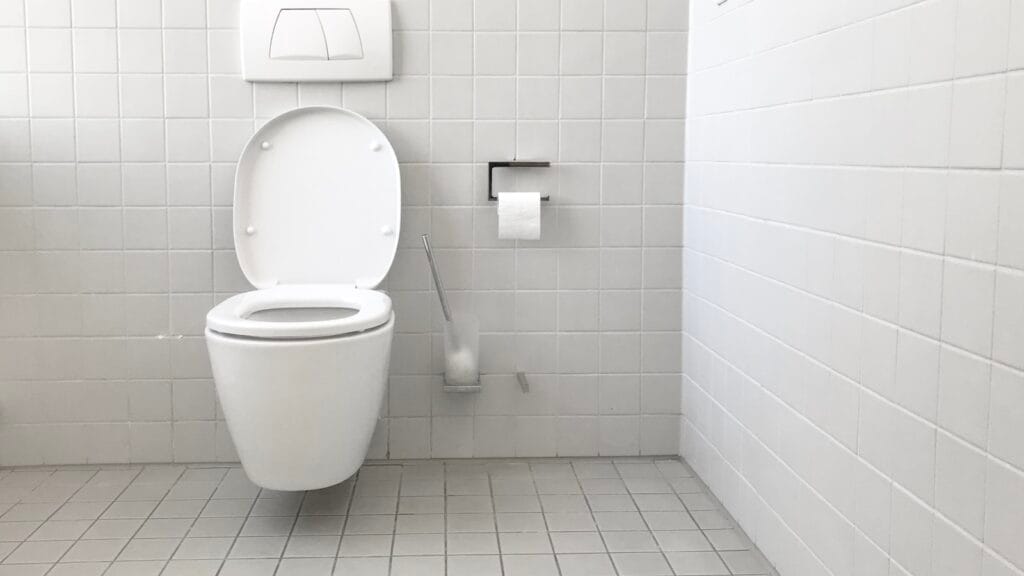
This is the step that catches everyone. Aussie pans come in three broad shapes: D-shape (most common — rounded front, flat back), square (Caroma Cube, Stylus Symphony, Fowler Aspire), and round (older 1980s–90s suites). The seat hinge geometry differs across all three, and within “D-shape” the bolt-hole spacing varies by brand. Bunnings universal seats (Mondella, Estilo, Kado-branded) only fit standard D-shapes. If you have a Caroma Cube, a Stylus Symphony, a Caroma Liano or a Fowler Newport, you need a brand-specific seat from Reece, Tradelink or directly from Caroma. A genuine Caroma Cube seat is around $145; a knockoff that “looks the same” will sit 8 mm proud at the back and rattle every time you sit on it.
Photograph the pan from above, the cistern label, and the existing bolt-hole spacing centre-to-centre. Send those to the Reece bloke and hell match it.
Step 2: Work out top-fix vs bottom-fix
Lift your existing seat lid and look at where the seat hinge bolts to the bowl. If you see two bolt heads on top of the porcelain (usually plastic caps), and underneath the bowl rim there’s no nut visible — that’s a top-fix. The bracket has expanding plugs that grip blind holes in the porcelain. If you see a threaded brass shaft passing right through the porcelain with a wing nut or hex nut underneath — that’s a bottom-fix. Most pans made in the last 15 years are top-fix because its quicker on the production line. Older Caroma Caravelle, Fowler suites and almost everything pre-2005 is bottom-fix. Buying the wrong type means the bolts physically wont engage no matter how much you swear at them.
Step 3: Remove the old seat — bottom-fix
Reach behind the bowl and feel for the wing nut on the underside. Hold the bolt head on top steady (slotted for a flathead, or capped). Undo the nut anti-clockwise. If its seized — and on anything older than 10 years it usually is — soak it in white vinegar for 20 minutes and try again. If it still wont shift, wedge a hacksaw blade (no frame) between the nut and porcelain and saw through the bolt. Dont use a full hacksaw — youll crack the bowl, and a cracked Caroma is a $400 problem.
Step 4: Remove the old seat — top-fix
Most modern top-fix seats have a quick-release button or slider on the hinge. Press it and lift the whole seat up and off. With the seat removed, you’ll see two plastic plugs in the porcelain. Some are unscrewed with a flathead, some pop out with a sharp upward pull, and Caroma’s are a quarter-turn lever. If you cant tell, look up your model on the Caroma support site — they have diagrams for every pan they’ve made since 1995.
Step 5: Clean the porcelain properly
Prep matters. With the old seat off, you’ll see two crescents of grime where the rubber bumpers sat. Hit it with white vinegar, leave for five minutes, then scrub with a microfibre. Finish with metho on a clean cloth so the new bumpers seat on a dry, oil-free surface. Skip this and the new seat will rock within a fortnight as the bumpers settle into the grime layer. The missus pointed out I’d skipped this step on our own seat install at home — sat skew for a month before I redid it.
Step 6: Fit the new brackets
For top-fix, push the expanding plugs down into the porcelain holes until the shoulder is flush. Tighten the centre bolt clockwise — you’ll feel the plug expand and grip. Stop the moment its firm. Over-tightening cracks the porcelain around the hole, which is the other way people kill a $400 pan. Snug, not gorilla. For bottom-fix, drop the bolt through the bracket, through the porcelain, and finger-tighten the wing nut underneath. Dont go full noise yet — you want movement to align the seat in Step 7.
Step 7: Fit the seat and check the lid clearance
Slot the seat onto the brackets (most modern ones click into place). Now do two checks. Lift the lid all the way back. It should stop before it touches the cistern. If it clouts the cistern — and on Caroma close-coupled suites this is the #1 install fault — your brackets are too far forward. Loosen, slide back 5–10 mm, retighten. Sit the lid down and eyeball the gap between the seat and the bowl rim at the front. Should be even left-to-right. If its skewed, the brackets aren’t square.
Step 8: Final tighten and bumper check
Once the seat sits true and the lid clears the cistern, tighten everything down. For top-fix that’s the centre bolt on each bracket. For bottom-fix, hold the bolt head on top with a flathead and tighten the nut underneath with the spanner. Firm, not heroic. Caroma’s official spec is 4 Nm — about the torque you can apply with a stubby spanner using two fingers. Now look at the four rubber bumpers on the underside of the seat. All four must contact the porcelain when the seat is down. Press each corner of the seat in turn — if any corner rocks, that bumper isn’t seating. Most quality seats have screw-adjustable bumpers; turn them out a half-turn until contact is solid.
Step 9: Test the soft-close (if fitted)
Modern seats almost all have soft-close hinges. Lift the lid to vertical and let go. It should descend slowly and silently, taking 4–7 seconds to close. If it slams, the dampers are dud or the lid is on backwards (yes, this happens — I’ve seen it twice). If it sticks halfway, the hinge needs a drop of silicone — never WD-40, which kills the damper grease and turns a slow-close into a no-close inside a week.
Step 10: Clean up and check again in a week
Wipe the bowl down, pop the bolt caps on (top-fix only), and walk away. Come back in a week and re-check the bracket tightness — porcelain and plastic settle, and a quarter-turn nip-up at day seven stops the wobble that develops in month two. Add this to your home maintenance log so you remember next time. For related toilet maintenance see our replace toilet inlet valve guide.
When to call a tradie
Toilet seat is the easiest plumbing job there is — homeowner DIY everywhere. Call a licensed plumber when its more than the seat. Cracked porcelain anywhere on the pan or cistern — full replacement, licensed work because the cistern-to-pan doughnut washer is restricted. Wobbling pan on its floor mount — the floor flange or sewer connection needs attention, licensed only. Cistern leaks (water on the floor behind the toilet that’s not from the bowl) — flexi hose, stop tap or supply line, licensed in QLD/NSW/VIC. AS/NZS 3500 is the standard; staying inside the homeowner-DIY zone means seat, inlet valve and tap washers only. Cheaper to do once.
Common screw-ups
- Wrong shape seat. Bunnings universal fits D-shape only. Cube, Symphony, Liano need brand-specific.
- Top-fix vs bottom-fix confusion. Bolts won’t engage, seat won’t sit. Identify before buying.
- Over-tightening bracket bolts. Cracks the porcelain, $400 pan replacement.
- Skipping the porcelain clean. Bumpers seat into grime, seat rocks within a fortnight.
- WD-40 on a soft-close hinge. Kills the damper, lid slams. Silicone only.
Cost & time
$39–$170 for the seat depending on brand and shape (Bunnings universal $39, genuine Caroma Cube $145, premium Caroma Liano $170). Time: 15 minutes for top-fix on a modern pan with a quick-release seat already fitted, 30–45 minutes for bottom-fix on an older suite where you have to lie on your back behind the bowl. Genuine savings vs a plumber callout ($180+ in southeast QLD).
The Tomo rule — wrap
Photograph the pan before you go to the shop, and ask the Reece bloke to match it — dont trust the box. Bunnings universal seats fit standard D-shape Caromas and not much else. If you’ve got a Cube, a Symphony, a Liano or anything square, factor $120–$170 for a genuine seat and dont try to save $80 with a knockoff. The knockoff will rock, the brackets will fatigue, and youll be doing the job again in eight months. Snug the bolts, never gorilla them — cracked porcelain is a whole-pan replacement, which is a licensed plumber job and a whole different price bracket. Got a tricky pan or a Caroma model that fights you? Send us a write-up.