How to Deep-Clean a Bathroom in 30 Minutes
Last Tuesday I cleaned a bathroom in a Newtown share-house that the four tenants had collectively decided was “beyond saving” — the grout was charcoal grey, the chrome had a fur coat of limescale, and the glass had that frosted look that isn’t frost, it’s calcified shampoo splash. They’d booked me for two hours. I was out in 34 minutes with a coffee in my hand on the way back to the car. Right, gear first — the secret isn’t elbow grease or fancy product, it’s order of operations and dwell time. Most people scrub immediately after spraying, which is like trying to eat soup before the kettle’s even boiled. Here’s the science of how to do it properly in half an hour.
Gear you’ll need
- Two microfibre cloths (one wet, one dry) — Kmart Anko 6-pack is fine
- An old soft toothbrush for grout edges
- A long-handled grout brush (Sabco or Coles Mr Muscle range — under $6)
- White vinegar (5% household strength) and bicarb soda — both from Woolies Essentials
- A non-bleach bathroom spray — Pine O Clean, Earth Choice, or Selleys 3-in-1
- A squeegee for the shower glass — the $9 Sabco at Bunnings
- A pair of cleaning gloves and a small bucket
- A timer (phone is fine)
Step 1: Pre-spray everything (top down)
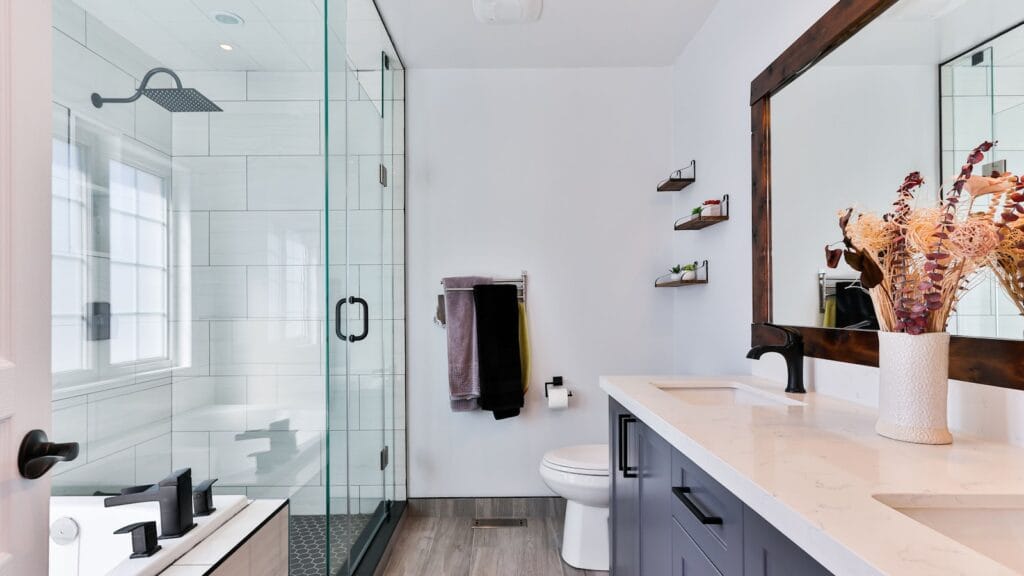
Walk in, spray the shower walls, glass, taps, basin and toilet seat with bathroom spray. Walk back out. Set a timer for ten minutes. Do not start scrubbing yet. Here’s the science — every bathroom spray is a surfactant solution, and surfactants need contact time to break the bond between soap scum and the tile surface. Scrub before the surfactant has done its job and you’re just smearing grime. Dwell time is everything.
Step 2: While the spray dwells — clear the bathroom
Take everything off every surface. Bath mats out the door, bins out, tubes and bottles into a basket, toothbrush holder into the basket. A clear bathroom genuinely cleans itself in a quarter the time of a cluttered one — you stop wasting strokes moving things around. I do this in 90 seconds flat. The basket of bottles lives in the hallway until step 10.
Step 3: Mix a grout paste in a small cup
Two tablespoons of bicarb soda, a splash of white vinegar, a splash of warm water — stir to a thin toothpaste consistency. The chemistry: bicarb is alkaline (pH around 9), vinegar is acidic (pH 2.4). When they meet, they fizz off carbon dioxide and water, leaving behind sodium acetate — which is mildly abrasive and a gentle surfactant. The fizz physically lifts gunk out of the grout pores. Skip this step if your grout is already white, or you’ve already used the method in our grout-mould tutorial recently.
Step 4: Brush grout while the spray still works on the tiles
Apply the bicarb paste along the grout lines — floor first (always worst, gravity wins), then walls. Scrub with the long-handled grout brush in straight lines along the grout, not in circles. Don’t rinse yet. The paste needs to fizz and lift for another few minutes while you move on. If your grout has black or pink mould rather than just grime, the bicarb won’t kill it — you’ll need the proper peroxide method.
Step 5: Wipe down tiles top to bottom
Back to the sprayed walls. Wet microfibre cloth, top-down, long horizontal sweeps. The 10-minute dwell has done about 80% of the work — your job is just lifting the loosened grime. If you find yourself pressing hard, the spray needed more dwell time, not more pressure. Rinse the cloth in the bucket as you go so you’re not redepositing.
Step 6: Squeegee the glass
Spray glass cleaner (or a 50/50 vinegar-water mix) on the shower glass, squeegee top-to-bottom in overlapping vertical strokes, wipe the squeegee blade between strokes on a dry cloth. Streak-free in two minutes. Common mistake — not overlapping strokes by about 2cm. Skip the overlap and you get visible vertical streaks every time the sun hits the glass at a low angle. If the glass has heavy calcium scale (the cloudy look), the squeegee won’t fix it — see our shower scale tutorial for the oxalic acid method.
Step 7: Taps and chrome — the vinegar wrap trick
Soak a microfibre cloth strip in white vinegar, wrap it around the tap base where limescale builds, leave for two minutes while you do step 8. Unwrap, scrub with the soft toothbrush, rinse. Here’s the science — limescale is calcium carbonate, vinegar is acetic acid, and acid plus carbonate produces a soluble calcium acetate that wipes off. Skip the fancy spray, just use vinegar. The wrap holds the acid in contact long enough to actually work — alot of people spray and immediately wipe, and wonder why the scale won’t budge.
Step 8: Toilet — inside first, then outside
Bowl: a couple of tablespoons of bicarb dropped in, splash of vinegar, scrub with the toilet brush, leave for a minute, flush. Outside: a fresh microfibre and bathroom spray over the seat, lid, base, and behind the bowl (where everyone misses). Use a separate cloth from the one you’ve used elsewhere — cross-contamination from the toilet area to a basin you’ll wash your face at tomorrow is exactly the thing you don’t want. I keep a red microfibre in my caddy that lives exclusively for toilet duty.
Step 9: Floor last — rinse grout, then mop
By now the grout paste has been sitting 15+ minutes. Wet a fresh cloth and rinse the grout lines, scrubbing one more pass with the brush as you go. Then mop the floor with warm water and a splash of vinegar. Don’t use a soap-based mop solution on tiled floors — it leaves a film that grime sticks to within a week. Plain warm water and a splash of vinegar is all you need. Mop from the back corner toward the door so you’re not walking on your clean floor.
Step 10: Dry surfaces, replace items, rehang mats
Dry microfibre over the basin, taps and mirror. The dry pass is what gives you that gleaming finish — wet surfaces always look streaky no matter what product you used. Replace your basket of bottles, toothbrush, soap. Mats back. Stand at the door and look back — anything you missed will jump out from this angle. Done.
When you should NOT DIY this
If you have heavy black mould spreading widely across porous surfaces — ceiling, plasterboard above the shower, behind the silicone — that’s professional mould remediation territory, not a cleaning job. Disturbing widespread spores in a sealed bathroom is a real respiratory risk. Same goes for pre-1970 bathrooms where paint may contain lead — sanding or aggressive scrubbing releases lead dust. If your bathroom is genuinely failing (waterproofing membrane breached, tiles drumming when tapped), no amount of cleaning fixes that — you’re looking at a re-grout or a re-waterproof under AS 3740, both bigger jobs than a Saturday morning.
Common screw-ups
- Scrubbing immediately after spraying — surfactant hasn’t had dwell time, you’re working twice as hard for half the result.
- Using bleach-based spray on coloured grout — fades the grout pigment within a few cleans and now you’ve got a mottled floor.
- Mixing bleach and vinegar in one session (or worse, in one container) — produces chlorine gas. Never combine.
- Soap-based mop solution on tiles — leaves a sticky film that attracts more dirt and means you’re cleaning twice as often.
- Using the same cloth on the toilet and the basin — genuinely unhygienic, colour-code your cloths.
The Kmart caddy system — why colour-coding cloths matters
The single best $12 I’ve spent on cleaning gear is the Kmart Anko cleaning caddy plus a 6-pack of colour-coded microfibres. Red lives in the toilet zone, blue does basins and taps, yellow does glass, green does floors. No cross-contamination, no wondering which cloth you used where, and they all wash together at 60°C in the front-loader once a fortnight (and yes, I clean my own washing machine monthly using our front-loader routine — biofilm builds up exactly as fast in cleaners’ machines as anyone else’s). The whole bathroom kit fits in one caddy: spray bottle, vinegar, bicarb tub, four cloths, grout brush, squeegee, gloves. Picks up, goes to the bathroom, walks out. Single-trip routine, no running back to the laundry mid-clean.
Cost & time
Total spend if you don’t own anything: about $35 for the spray, microfibres, squeegee, grout brush and gloves — most of which last a year. The Kmart caddy is another $8. Time: 30 minutes start to finish once you’ve done it twice. The first time will take 45 because you’re learning the order. Compared to a paid bathroom clean at $80-120 in Sydney, the kit pays for itself the first session.
Right, that’s the routine. Pre-spray, walk away, let the chemistry do the cleaning while you do other things, then lift it off in order. The single biggest change for most people is the ten-minute dwell — every “stubborn” bathroom I’ve ever been called to was a case of the owner scrubbing immediately after spraying. Patience beats elbow grease every time. If your grout’s still grey after this, it’s not dirt anymore — it’s stained or mouldy, and you need the grout-mould method next. Caddy out, let’s go.